Goa!

Sunday September 17, 2017

We got up very early, before 6am. We wanted to have time to put our foot in the Arabian Sea. 


We walked over to the fort


It was not raining, well it was not raining really hard


I am looking forward to playing a little with this photo, the blue boat, the yellow rain slicker on the fisherman and the grey of the water and the sky!


 The hotel staff gave us a big stick to keep us safe from the wild dogs of Goa.  They looked pretty happy, and they left us alone.


Feet in the Arabian Sea!


aw, a picture of us together!


Palm trees. Very different from northern India

Our hotel grounds during the day light hours


Time for breakfast!

I took this photo of the doughnut tree for Lon.


It was really hard to check out of this hotel. We wanted to stay at least one more night.
The hotel was out of the main area of Goa, so it was so quiet, the grounds were beautiful.


some pictures from the bus


Mark was brave and went out in the rain to explore some of the streets. I will post his pictures in the next blog. He takes some very good photos!

The rain had stopped and I went with everyone to the fruit and vegetable market

The mural in the market

It was so colorful! Someone (and I can not remember who) bought some custard apples. Yummy, another fruit I like!


The Se Cathedral.

The word Sé is Portuguese for See. The Se Cathedral was built to commemorate the victory of the Portuguese under Afonso de Albuquerque over a Muslim army, leading to the capture of the city of Goa in 1510. Since the day of the victory happened to be on the feast of Saint Catherine, the cathedral was dedicated to her.
It was commissioned by Governor George Cabral to be enlarged in 1552 on the remains of an earlier structure. Construction of the church began in 1562 in the reign of King Dom Sebastião. The cathedral was completed in 1619 and was consecrated in 1640. It had two towers, but one collapsed in 1776 and was never rebuilt

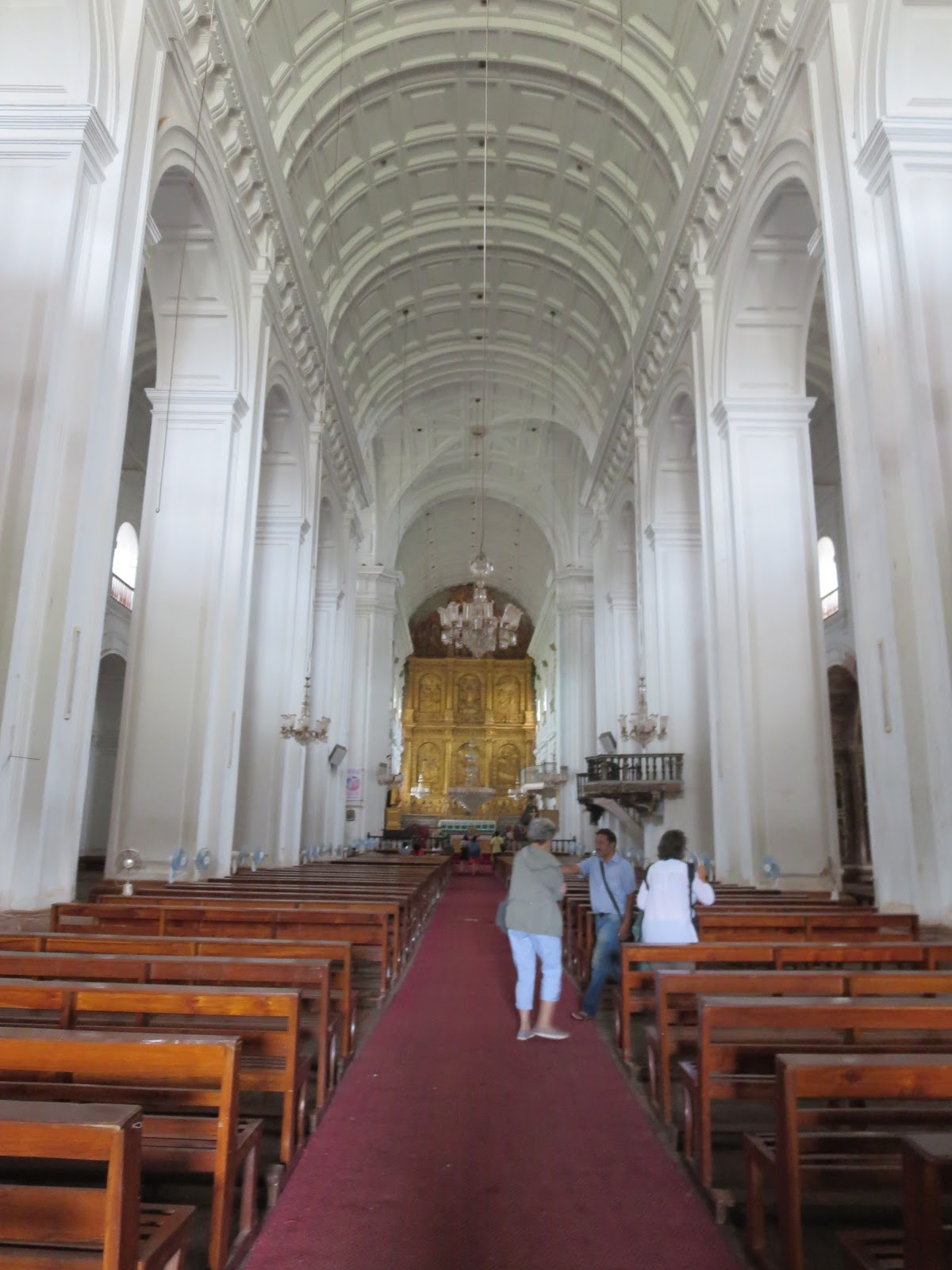


It is a beautiful  church


The chandeliers were imported from Belgium.


A baptismal font.


Basilica of the Bom Jesus.

The Basilica of Bom Jesus or Borea Jezuchi Bajilika (Portuguese: Basílica do Bom Jesus) is located in Goa, India, and is a UNESCO World Heritage Site. The basilica holds the mortal remains of St. Francis Xavier. The church is located in Old Goa, which was the capital of Goa in the early days of Portuguese rules
'Bom Jesus' (literally, 'Good (or Holy) Jesus') is the name used for the Ecce Homo in the countries of Portuguese colonization. The Jesuit church is India’s first minor basilica, and is considered to be one of the best examples of Construction work on the church began in 1594. The church was consecrated in May 1605 by the archbishop, Dom Fr. Aleixo de Menezes. This world heritage monument has emerged as a landmark in the history of Christianity. It contains the body of St. Francis Xavier, a very close friend of St. Ignatius Loyola with whom he founded the Society of Jesus (the Jesuits). Francis Xavier died on Sancian Island while en route to continental China on (December 13, 1552).
The body of Francis Xavier was first taken to Portuguese Malacca and two years later shipped back to Goa. It is said that the saint's body was as fresh as the day it was buried. The remains of the saint still attract a huge number of tourists (Christian and non-Christian alike) from all over the world, especially during the public viewing of his body every ten years (last held in 2014). The saint is said to have miraculous powers of healing.
This is one of the oldest churches in Goa and in India. The floor is of marble inlaid with precious stones. Apart from the elaborate gilded altars, the interior of the church is simple. The main altar holds a large statue of St. Ignatius of Loyola, the founder of the Society of Jesus (Jesuits), and one of Francis Xavier's companions whose words drew him to a reformed life. "What does it profit a man," Ignatius had asked Francis, “if he gains the whole world and loses his soul?"
The Baroque style main altar is gilded and bears the statue of Ignatius of Loyola standing between Solomonic pillars above which is the name of Jesus in the IHS monogram and the Holy Trinity
The gaze of the gilded statue of Ignatius of Loyola is fixed upwards in awe at the name of Jesus (IHS) on the gilded emblem of the Jesuits, encircled in radiant rays. Over the emblem, is the Holy Trinity -Father, Son and Spirit - the ultimate muse and focus of the pious Christian. The altar table which is used in Holy mass is gilded and adorned with the figures of Christ and his apostles at the Last Supper, along with the words "Hi Mhoji Kudd", which in Konkani means "This is my Body", from the Institution Narrative.
The church also holds paintings of scenes taken from the life of St. Francis Xavier. The mausoleum, on the top of which is placed the silver casket with the body of St. Francis Xavier (1696), was the gift of the last of the Medicis, Cosimo III, the Grand Duke of Tuscany.
The mausoleum was designed by the 17th-century Florentine sculptor Giovanni Battista Foggini. It took ten years to complete. The casket containing his body is made of silver. The holy relics of the saint are displayed every ten years during the anniversary of the saint's death. His liturgical feast is 3 December.
On the upper level, overlooking the tomb, is the Bom Jesus Basilica Art Gallery, containing the works of the Goan surrealist painter, Dom Martin.
Author and fellow Jesuit Anthony De Mello was also from Goa and mentions the basilica in his writings.The body is shown every ten years
The Basilica of Bom Jesus is more than 408 years old and is open to the public every day. The body of St. Francis Xavier is in a well-decorated casket, which can be seen in the photographs below. Solemn exhibitions of the 'body' are held every ten years. Some photos taken inside the church are attached for better understanding of the art work of that time. These art works are called "murals".baroque architecture in India.


  The churches, SE and Bom Jesus, reminded me very much of the older Portuguese churches in Brasil.   Goa looked very familiar in that respect.

From here, we were back to the airport for a flight to Mumbai and an over night in Mumbai

Going to Goa!

Saturday September 16, 2017 Jaipur-Mumbai_ Goa

We learned about air travel within India!  It is an amazing amount of security to go through. The ladies and gentlemen have separate screening lines.  The men have 7 lines to get through carry on bag check and body screening. The ladies have 1. Yes, one.  It took a long time for the ladies to get through. This was not just Jaipur, but every airport.

 Everything was in English and in Hindi.  The written things too


Mumbai airport tarmac

Welcome to rainy Goa!

The streets of Goa

Lots more churches in Goa

The view from our hotel.
It was sad we were only going to be here one night.


Our hotel grounds at night

I told Mark I was tired of curry all the time, and I wanted something like pasta for dinner.  There were two restaurants in the hotel.  One happened to be Italian. Mark humored me and we went there.  Barbara and Diane joined us. It was a very nice dinner. Quiet. Our waiter was very informative. We were the only table in the restaurant for a long time, but it never got busy. We were given desserts, it was a very fun evening.  We then went over to the other restaurant. I am so happy we went to the Italian place. There was a band playing at the second place. It was so loud in there. The waiters could not hear, so the orders were not right. No one was happy with their meals. 
It was a long day of airplane travel, so we called it a night. 

Mark's Jaipur Pictures.

Friday, September 15, 2017 Jaipur

Leaving the Amber Fort

The sculpture of the children is wonderful!

Printing fabric

I got to print a bit of cotton!

all the blocks that were used to make the little colorful elephant. I wish we would have been able to keep the elephant, but they said no.

Who these ladies were or what they were doing was not ever mentioned.   They may be putting the binding on the carpets

The rug/fabric company had us take our shoes off so we could feel how wonderful these carpets really were.  They had many different fibers. Camel, wool, cotton, silk and blends.

Hawa Mahal, palace of the wind.


The packed streets.

Up close of a Holy Cow

 The Jantar Mantar, as promised in the last blog, here is the information bit

There are plenty of observatories all over the world, but the Jantar Mantar is considered to be one of the largest observatories ever built. Combining religion, science and art, the Jantar Mantar is the name given to a series of five, magnificent structures built in Jaipur, New Delhi, Ujjan, Varanasi and Mathura. Jaipur was the seat of Maharaja Jai Singh II during the 1720's and this is when this magnificent structure was built here. The Jantar Mantar in Jaipur is considered to be the largest of the five observatories and also houses the world's largest sundial. The Universe and the Cosmos have always been of interest to man, and it was this interest that compelled the Maharaja to build an astronomical observatory. The term 'Jantar Mantar' is derived from the Sanskrit terms 'Yantra' and 'Mantra' meaning 'instruments' and 'formula' respectively. The term 'Yantra' was replaced with 'Jantar' which means 'magical'. The Jantar Mantar houses various architectural and astrological instruments that have caught the interests of astronomers, historians and architects around the world.
History
Maharaja Jai Singh II, the founder of the 'pink city', was a great scholar and an avid astrologer. He studied philosophy, astrology, architecture and religion in various schools, and was also well versed with universal mathematical concepts such as Euclid's Clements, Ptolemy's Syntaxes and the Master works of Aryabhatta. In the year 1718, he wanted to construct an observatory of renown. For this, he studied the subject of astronomy and then built five different observatories around North India. At these places, he would sit with other scholarly astronomers, such as Pt. Kedarnath, for astronomical observations. The 'Jantar Mantar' at Jaipur, being the biggest conservatory in the country, was renovated time and again and houses various instruments that offer precise measurements of time, the azimuth, declination of the sun and the positions of constellations, along with several other astronomical phenomena. The Jaipur observatory was functional for seven years only, as the Maharaja was not very successful in deriving accurate, astronomical observations.
Architecture
The astronomical observatory consists of fourteen major geometric devices for measuring time, tracking constellations and, even for, observing the orbits around the sun. Popular structures within the Jantar Mantar are the 'Samrat Yantra' (the world's largest sundial), the 'Hindu Chhatri', the 'Jaiprakash Yantra' and various geometric structures with astronomical devices to probe the 'universe'.


Pictures of our family's astrology symbols


The City Palace: 
Information Bit from Jaipur.org

Located in the heart of the Pink City Jaipur, the City Palace was where the Maharaja reigned from. This palace also includes the famous 'Chandra Mahal' and 'Mubarak Mahal', and other buildings which form a part of the palace complex. The palace is located towards the northeast side of central Jaipur and has many courtyards and buildings. The palace was built between 1729 and 1732 AD by Sawai Jai Singh II. He ruled in Amer and planned and built the outer walls of the palace and later rulers added to the architecture of this palace. These additions have been known to take place right up to the 20th century. The urban layout of the city of Jaipur was commissioned to Vidyadhar Bhattacharya and Sir Samuel Swinton Jacob. The architectural styles are largely based on a fusion of Rajput, Mughal and European styles. Today, the 'Chandra Mahal' has been turned into a museum which is home to unique handcrafted products, various uniforms of the rulers and many more things pertaining to the royal heritage of the City Palace.
History Of City Palace
Maharaja Sawai Jai Singh II is known to have commissioned work for building the outer wall of the city's complex. He shifted from Amer to Jaipur due to water problems and an increase in population in 1727. He had entrusted the city's architectural design to the chief architect Vidyadhar Bhattacharya. The architect went on to design the City Palace in accordance with the Vaastushastra texts.
Architectural Layout
The City Palace reflects Rajput, Mughal and European architectural styles although the palace was designed to Vaastushastra treatise. Some of the famous gates are the 'Udai Pol', 'Jaleb Chowk', 'Tripolia Gate' and 'Virendra Pol', which also happen to be the various entrances to the palace. These are all richly decorated. The Palace has been designed according to a 'grid style' and houses various structures such as, 'Chandra Mahal', 'Mubarak Mahal', 'Diwan-I-Khas' and the 'Govind Dev Ji Temple. The walls and gates are ornately designed to Mughal style, with various murals, lattice and mirrors adorning them from sides.


After the City Palace we went to a jewelry store. 
This is a man polishing stones by hand. 

Raw minerals, polished into beautiful stones

To me the store itself was not the quality for the price I wanted to pay. We did not buy anything there.  We found a wonderful tiny jeweler in the hotel, and I bought two rings and two earrings there.  It was so fun to shop with a few friends, we giggled and cajoled each other into getting what we really wanted. 

Elephants on parade

Camels

He looks like he was posing! 


we found this amusing


Our day is over in Jaipur.   Our next day is mainly airports


two year

 Keeping this alive for the moment